POPPUR爱换

标题: NVIDIA Kal-El Cortex A9 四核架构 SOC 及开发平台 [打印本页]

作者: Edison    时间: 2011-2-16 14:25
标题: NVIDIA Kal-El Cortex A9 四核架构 SOC 及开发平台
[attach]1474616[/attach]

[attach]1474615[/attach]

[attach]1474614[/attach]

[attach]1474613[/attach]


http://www.engadget.com/2011/02/ ... s-it-in-tablets-by/

So it turns out that NVIDIA roadmap we saw last month was as true and pure as driven snow. The barely conceivable quad-core Tegra chip that it listed has now been made official by none other than NVIDIA itself, with the company also informing us that the new silicon is already sampling out to prospective clients. Known as Kal-El internally, this will most likely turn into NVIDIA's Tegra 3 as and when it's ready to enter the consumer market. Tonight NVIDIA whetted our appetite for what's to come with a demo that can most fittingly be described as an exhibition of unadulterated computational muscle. A 2560 x 1440 stream was being decoded on a developmental device, scaled down to that slate's native 1366 x 768 resolution, and additionally displayed on a connected 30-inch, 2560 x 1600 monitor. That entire voluminous workload was being handled in real time by Kal-El and we saw no signs of it struggling.

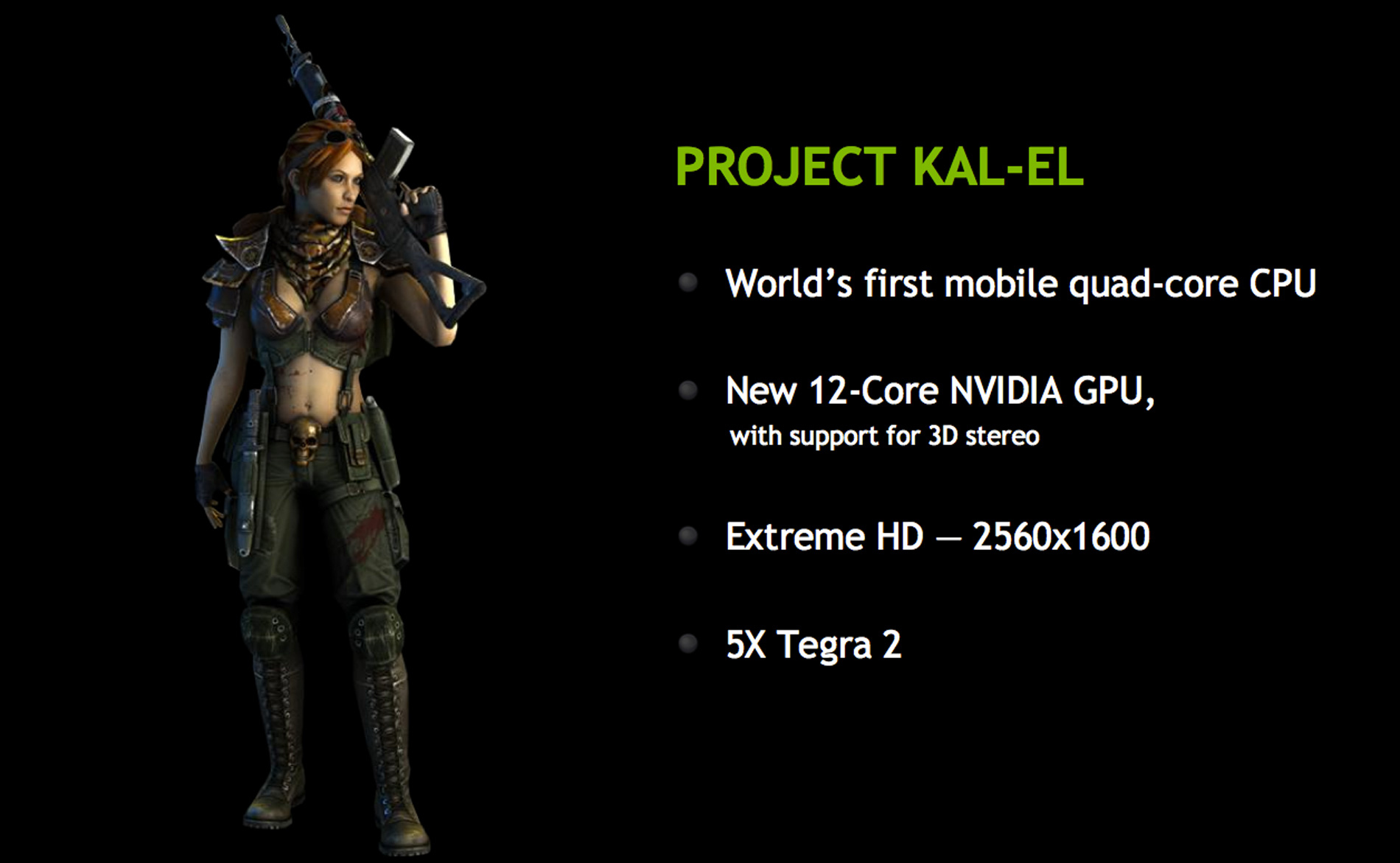
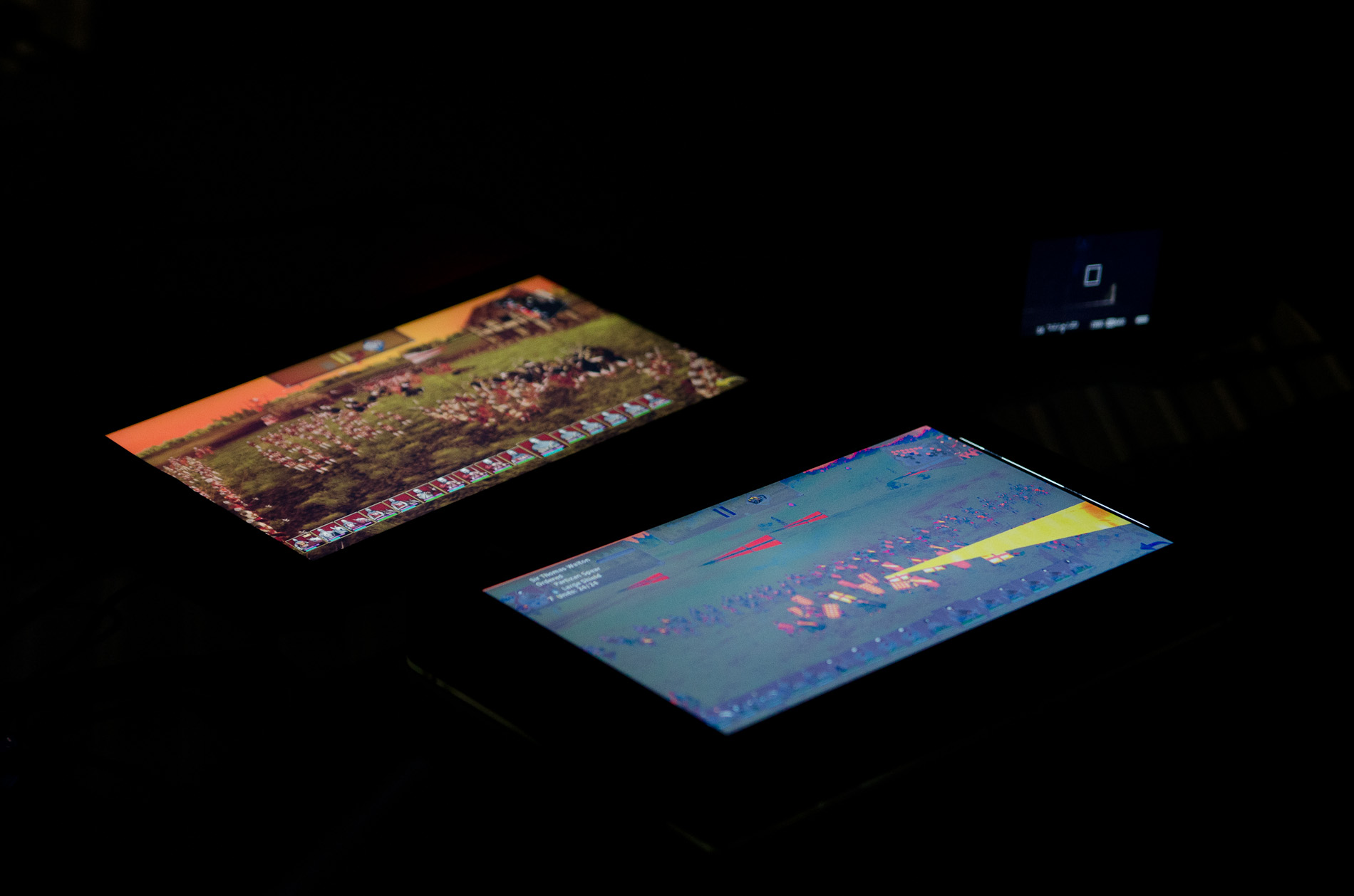
By NVIDIA's own estimation, the quad-core newbie provides roughly double the processing power of Tegra 2 and triple the graphics-crunching prowess. In the second demonstration of the evening, we saw an instance of Great Battles Medieval -- ran at 720p with 650 enemy soldiers on the field -- on both a Tegra 2 and a Kal-El platform, which showed the baby superhero handily dusting its still very new brethren. This was in large part down to the full dozen GPU cores contained within Kal-El, though before you freak out about battery-draining insanity, NVIDIA claims things are much, much more efficient as well -- up to 12 hours of HD video playback are promised under the right circumstances.

It's a big fat wedge of awesome boasts we've heard from the GeForce maker today, however the company's given us a schedule to hold it to as well. The "August timeframe" is when the quad-core Kal-El is expected to land in tablets, while smartphones will have to wait until the holiday season to benefit from what's likely to be a slightly downgraded variant. Skip past the break to eye the future Tegra roadmap for the next few years plus video of the wildly impressive demos we were witness to.
作者: Answer4eveR    时间: 2011-2-16 14:28
Kal-El...
那不是超人的名字嘛
还用绿色的bar,不怕被氪死啊
作者: Asuka    时间: 2011-2-16 14:31
这次拿出的是实物,其它几家的还在纸上,NV干得好

高通TI这种垄断公司,不抽它们是不知道前进的
作者: goplayer361    时间: 2011-2-16 14:33
又开始指导性测试了?这数据。。。啧啧
作者: Edison    时间: 2011-2-16 14:33
http://www.anandtech.com/show/4181/nvidias-project-kalel-quadcore-a9s-coming-to-smartphonestablets-this-year/3


NVIDIA just dropped a bombs**. Not only is its third generation Tegra architecture, codenamed Kal-El, back from the fab but it's up and running Android after only 12 days. Kal-El will begin sampling soon and NVIDIA claims you'll be able to buy tablets based on it in August of this year, with smartphones following before the end of the year.

The SoC race just got a lot hotter, read on to find out what we know about Project Kal-El.

Page 1

If there's any one takeaway from both CES and Mobile World Congress this year it's that NVIDIA is unequivocally a player in the SoC space. With design wins from LG, Motorola and Samsung, NVIDIA may not have the entire market but it has enough of it to be taken seriously.

In our Optimus 2X Review I mentioned that it looked like NVIDIA was going to be moving to a 6-month product cycle in the SoC space. The intention is to out execute its competitors frequently enough that they are either forced out of the market or into making a mistake trying to keep up. It's the same strategy that NVIDIA used to compete with 3dfx almost fifteen years ago.

I wrote that in 2011 NVIDIA would release Tegra 2 followed by the Tegra 2 3D (a higher clocked version of the Tegra 2 with support for 3D content) and finally the Tegra 3 before the end of the year. While it wasn't too long ago that NVIDIA was telling people about its 6-month product cycle, things have changed.

The Tegra 2 3D looks like it's not going to happen. The higher clocked SoC is not currently in any designs that are in the pipeline. There are Tegra 2 based smartphones and tablets that are due out this year, but nothing based on T25/AP25 as far as I can tell.

Although the middle of the roadmap changed, it's the end of 2011 that's sort of amazing. Internally NVIDIA referred to this chip as Tegra 3, and externally we expected it at the tail end of 2011 with devices launching in Q1 2012.


NVIDIA got the first silicon back from the fab 12 days ago. While the chip may end up being called Tegra 3 or some variation of that, for now NVIDIA refers to it as Project Kal-El. Named after young superman (or Nicholas Cage's son), Kal-El will be sampling this year and shipping in devices as early as August 2011.

The Roadmap

I must say that this is highly unlikely behavior for a SoC manufacturer. Qualcomm recently announced its dual-core MSM8960 would be sampling in Q2 2011 and shipping in devices starting next year. NVIDIA is announcing sampling starting sometime very soon (the chip is only 12 days old after all) and device availability before the end of the year.

NVIDIA went on to be even more specific. Tablets based on Kal-El will be available starting August 2011, while smartphones will be available this Christmas and into the first half of next year. This is either NVIDIA over committing to an unrealistic future or the most aggressive schedule we've seen from an SoC vendor yet. NVIDIA won some points by actually pulling off the coup with Tegra 2 this year, however it's still too early to tell whether we'll see the whole thing repeated again just 9 months from now. I'm willing to at least give NVIDIA the benefit of the doubt here.


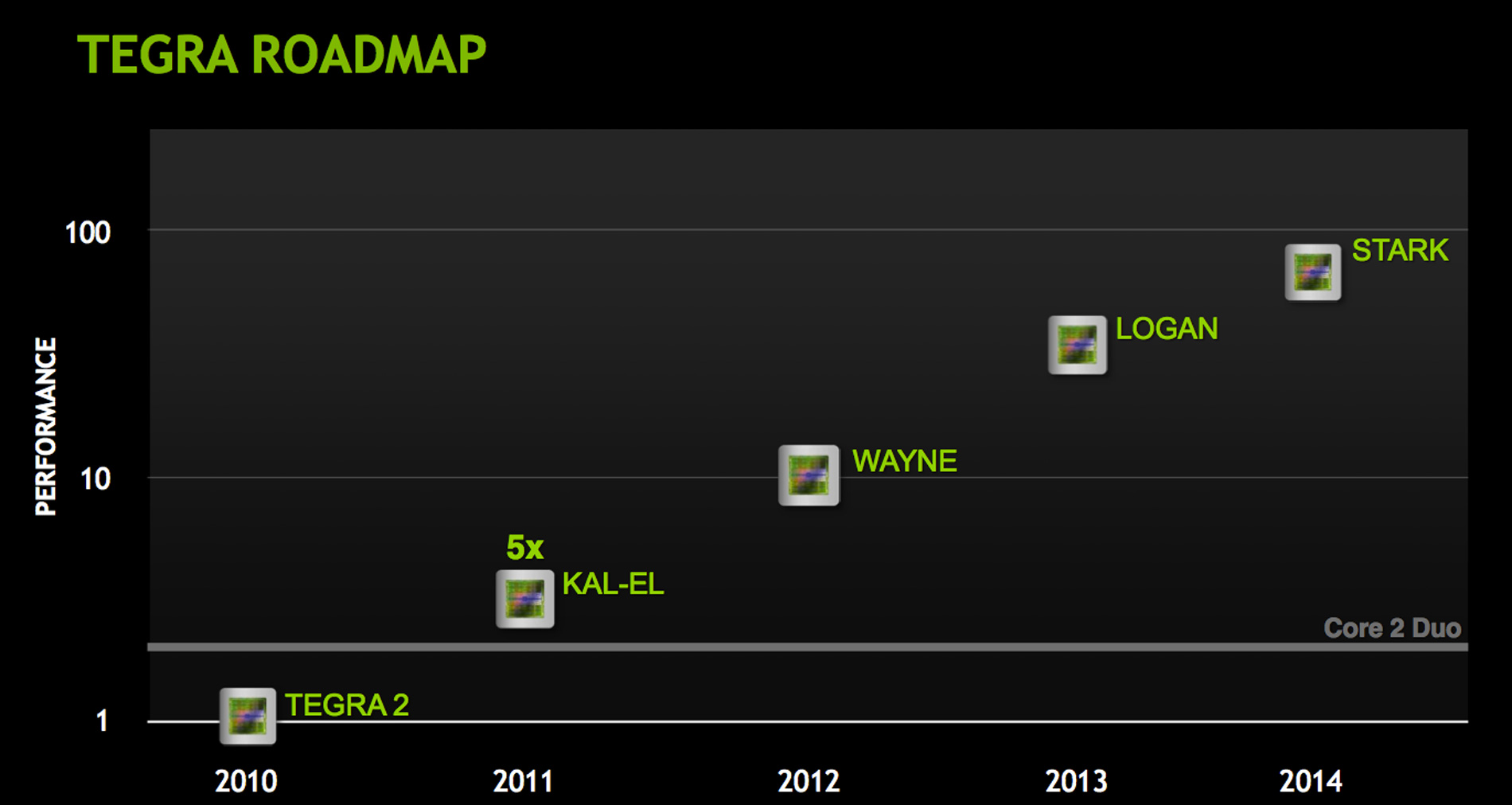
It doesn't stop with Kal-El either. NVIDIA is committing to a yearly refresh of its architecture, NVIDIA quantifies the move from Tegra 2 to Kal-El as a 5x increase in performance. By 2012 we'll have Wayne, which doulbes performance over Kal-El. Then we've got another 5x increase over Wayne with Logan in 2013. The furthest NVIDIA is willing to go out is 2014 with Stark, at roughly a doubling of the performance offered by Logan.

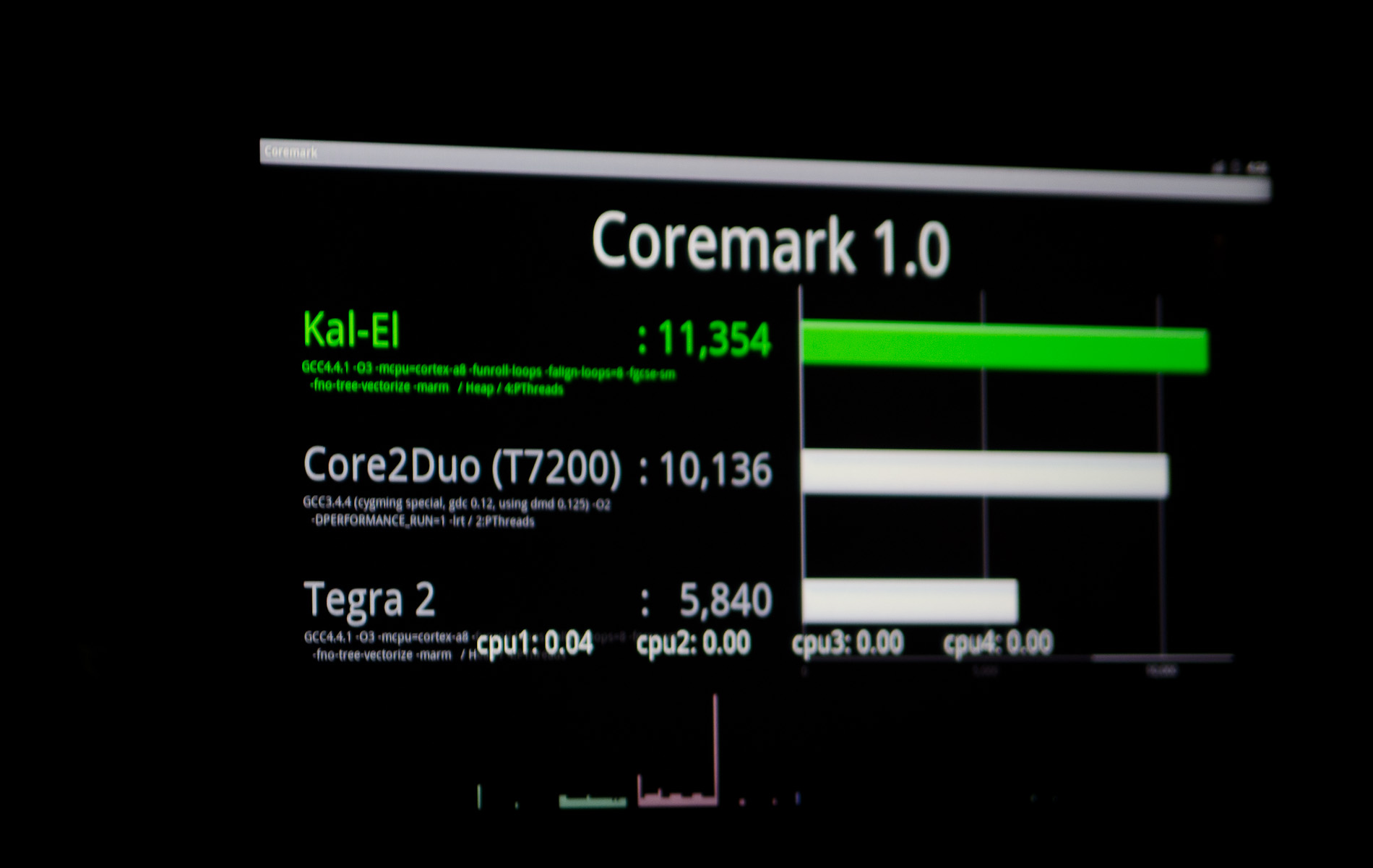
The baseline reference point is Tegra 2, which NVIDIA expects Stark to outperform by a factor of 100x. NVIDIA also expects Kal-El to be somewhere in the realm of the performance of a Core 2 Duo processor (more on this later).

Based on the cadence that NVIDIA presented, it looks like every year we'll either get a doubling or 5x increase in performance over the previous year. Kal-El is one of those 5x years, followed by a doubling with Wayne, 5x again with Logan and a doubling with Stark. Now the performance axis in the chart above is really vague, so end users will likely not see 5x Tegra 2 with Kal-El, but they will see something tangible at least.

Page 2 The Architecture

Kal-El looks a lot like NVIDIA's Tegra 2, just with more cores and some pin pointed redesigns. The architecture will first ship in a quad-core, 40nm version. These aren't NVIDIA designed CPU cores, but rather four ARM Cortex A9s running at some presently unannounced clock speed. I asked NVIDIA if both the tablet and smartphone versions of Kal-El will feature four cores. The plan is for that to be the case, at least initially. NVIDIA expects high end smartphones manufacturers to want to integrate four cores this year and going in to 2012.


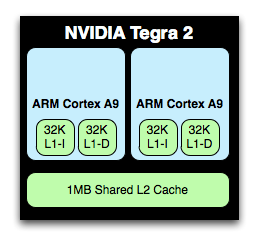
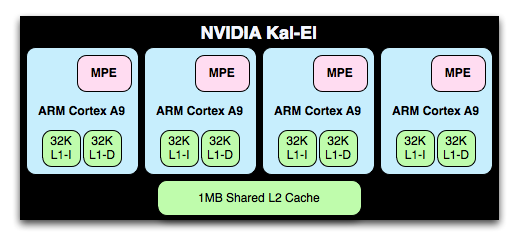
The CPU cores themselves have changed a little bit. Today NVIDIA's Tegra 2 features two Cortex A9s behind a shared 1MB L2 cache. Kal-El will use four Cortex A9s behind the same shared 1MB L2 cache.

NVIDIA also chose not to implement ARM's MediPro-Acessing Engine (MPE) with NEON support in Tegra 2. It has since added in MPE to each of the cores in Kal-El. You may remember that MPE/NEON support is one of the primary differences between TI's OMAP 4 and NVIDIA's Tegra 2. As of Kal-El, it's no longer a difference.


Surprisingly enough, the memory controller is still a single 32-bit wide LPDDR2 controller. NVIDIA believes that even a pair of Cortex A9s can not fully saturate a single 32-bit LPDDR2 channel and anything wider is a waste of power at this point. NVIDIA also said that effective/usable memory bandwidth will nearly double with Kal-El vs. Tegra 2. Some of this doubling in bandwidth will come from faster LPDDR2 (perhaps up to 1066?) while the rest will come as a result of some changes NVIDIA made to the memory controller itself.

Power consumption is an important aspect of Kal-El and Kal-El is expected to require, given the same workload, no more power than Tegra 2. Whether it's two fully loaded cores or one fully loaded and one partially loaded core, NVIDIA believes there isn't a single example of a situation where equal work is being done and Kal-El isn't lower power than Tegra 2. Obviously if you tax all four cores you'll likely have worse battery life than with a dual-core Tegra 2 platform, but given equal work you should see battery life that's equal if not better than a Tegra 2 device of similar specs. Given that we're still talking about a 40nm chip, this is a pretty big claim. NVIDIA told me that some of the power savings in Kal-El are simply due to learnings it had in the design of Tegra 2, while some of it is due to some pretty significant architectural discoveries. I couldn't get any more information than that.


Kal-El vs. Tegra 2 running 3D game content today at 2 - 2.5x the frame rate


On the GPU side, Kal-El implements a larger/faster version of the ULP GeForce GPU used in Tegra 2. It's still not a unified shader architecture, but NVIDIA has upped the core count from 8 to 12. Note that in Tegra 2 the 8 cores refer to 4 vertex shaders and 4 pixel shaders. It's not clear how the 12 will be divided in Kal-El but it may not be an equal scaling to 6+6.

The GPU clock will also be increased, although it's unclear to what level.


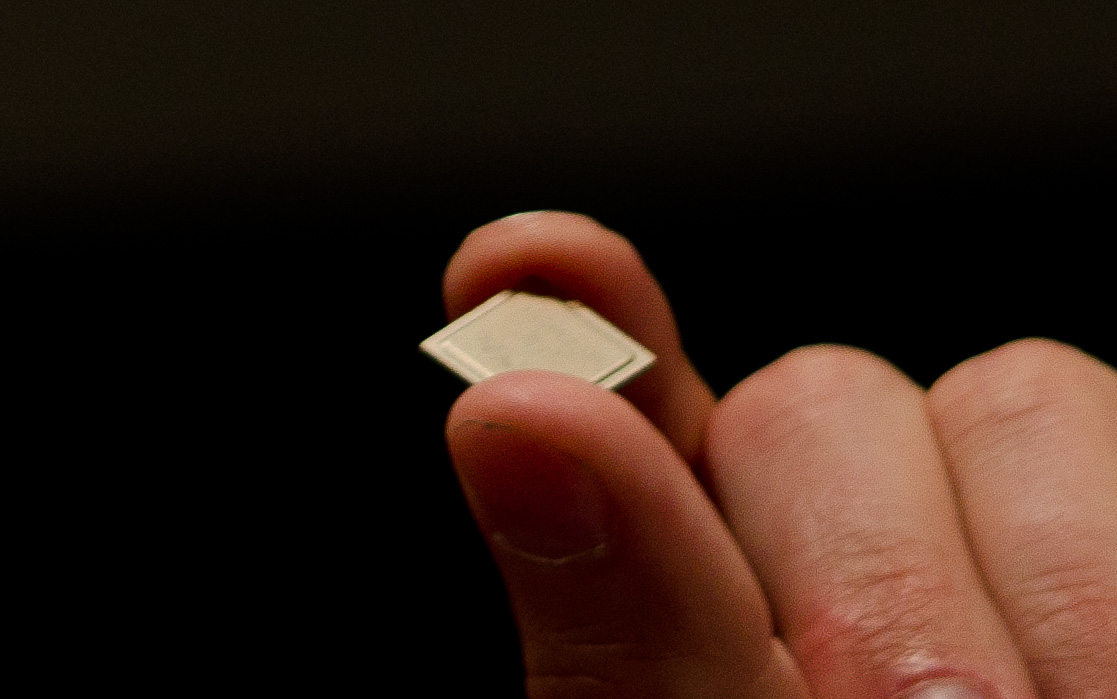
The combination of the larger GPU and the four, larger A9 cores (MPE is not an insignificant impact on die area) results in an obviously larger SoC. NVIDIA measures the package of the AP30 (the smartphone version of Kal-El) at 14mm x 14mm. The die size is somewhere around 80mm^2, up from ~49mm^2 with Tegra 2.
   

Page 3 Video DecodeOne of the stones we've thrown at NVIDIA is the lack of high profile H.264 decode support. Tegra 2 can decode main profile H.264 at up to 20Mbps, but throw any high profile 1080p content at the chip and it can't do it. This is Pro-Ablem because a lot of video content out there today is high profile, high bitrate 1080p H.264. Today, even on Tegra 2, you'll have to transcode a lot of your 1080p video content to get it to play on the phone.

With Kal-El, that could change.

NVIDIA's video decoder gets an upgrade in Kal-El to support H.264 at 40Mbps sustained (60Mbps peak) at a resolution of 2560 x 1440. This meets the bandwidth requirements for full Blu-ray disc playback. NVIDIA didn't just make the claim however, it showed us a 50Mbps 1440p H.264 stream decoded and output to two screens simultaneously: a 2560 x 1600 30" desktop PC monitor and a 1366 x 768 tablet display.

Did I mention that this is 12-day-old A0 silicon?

Kal-El also supports stereoscopic 3D video playback, although it's unclear to me what the SoC's capabilities are for 3D capture.

I asked NVIDIA if other parts of the SoC have changed, particularly the ISP as we've seen in both the Optimus 2X and Atrix 4G articles that camera quality is pretty poor on the initial Tegra 2 phones. NVIDIA stated that both ISP performance and quality will go up in Kal-El although we don't know any more than that. NVIDIA did insist that its own development Tegra 2 platforms have good still capture quality, so what we've seen from LG and Motorola may just be limited to those implementations.

Page 4 Final Words

The first thing everyone at NVIDIA asked me after I saw Kal-El running was an eager and expected: "well, what did you think?"

On the one hand, we have a clear underdog in the SoC space demonstrating a brand new chip just 12 days after getting it back from the fab. It's functional, it can render 3D games, it can decode high bitrate video and it runs Android today. The word impressive is insufficient to convey the magnitude of what I just described, particularly in the SoC space.


On the other hand, it's still just an announcement. It wasn't too long ago that NVIDIA was struggling to name a single design win. The recent success with LG, Motorola and Samsung is awesome, but it isn't a guarantee of what's to come. That being said, the handset vendors and carriers clearly take NVIDIA seriously today and they would be foolish not to consider Kal-El as it'll be the quickest way to get to quad-core in an Android phone.

Architecturally, Kal-El isn't a huge departure from what we currently have today with Tegra 2. If NVIDIA can increase clock speeds a bit we'll see better performance on lightly threaded workloads, but I'm not convinced of the gains to be had in single-tasking workloads from four cores in a smartphone/tablet. The bigger gains will likely come from any improvements to the memory controller as well as the faster GPU. This being said, NVIDIA does believe that even web page rendering can benefit significantly from a quad-core CPU so I could be very well proven wrong once devices are out in the wild.


If NVIDIA can secure significant design wins with Kal-El based tablets in August of this year and smartphones in Q4 I will be beyond impressed. NVIDIA gets major points for putting on good demos of working silicon today but in this business you need to have devices. For now we play the waiting game. I suspect if you're not taking NVIDIA seriously at this point, you really should be.
作者: the_god_of_pig    时间: 2011-2-16 14:36
看上去很美
作者: Edison    时间: 2011-2-16 14:36
goplayer361 发表于 2011-2-16 14:33
又开始指导性测试了?这数据。。。啧啧

Intel、AMD、NVIDIA 乃至 VIA 等等厂商全部都有所谓的测试指导,这类指导虽然有少数存在容易造成误导的东西,但是对于许多对测试一窍不通的人来说,是一个非常不错的参考,至少你得知道如何才能 Timedemo、fps log,如果这些算是指导性测试,你就不要看所有的测试报告了,无论是媒体还是民间。

Coremark 在 SOC 或者说嵌入式计算的地位相当于 SPEC.org 的 CPUXXXX(最新版是 CPU2006) 。

作者: goplayer361    时间: 2011-2-16 14:39
对nv的图表结果我印象最深的就是截一段再比较 结果看上去非常夸张的差距其实就是那么一点点这点我感觉其他商家还是不够给力啊
作者: Edison    时间: 2011-2-16 14:41
goplayer361 发表于 2011-2-16 14:39
对nv的图表结果我印象最深的就是截一段再比较 结果看上去非常夸张的差距其实就是那么一点点这点我感 ...

这个问题你自己如果不偏颇的话,大可以找出许多其他厂商类似的官方非零原点坐标对比图表。

作者: 380    时间: 2011-2-16 15:34
提示: 作者被禁止或删除 内容自动屏蔽
作者: xreal    时间: 2011-2-16 21:20

老黄威猛
作者: Heitai    时间: 2011-2-16 23:37
提示: 作者被禁止或删除 内容自动屏蔽
作者: Edison    时间: 2011-2-16 23:42
Heitai 发表于 2011-2-16 23:37
高通的4核是28nm的吧?

高通的是 Cortex A-15,不过时间依然落后同等级的 NVIDIA Tegra 4 一年。

作者: NV30F0    时间: 2011-2-17 02:21
12天的silicon,牛X
作者: SnakeLee    时间: 2011-2-17 06:00
等等,路线图上那些诡异的名字是咋回事?

这回是超人,下一代是蝙蝠侠,然后是金刚狼接着就是钢铁侠?


作者: 骨刺    时间: 2011-2-17 09:07
反正INTEL以后日子不会好过了
作者: gk104    时间: 2011-2-17 09:29
噱头好多,一会kalel一会logn..
作者: hxg_2001    时间: 2011-2-17 09:51
Edison 发表于 2011-2-16 14:41
这个问题你自己如果不偏颇的话,大可以找出许多其他厂商类似的官方非零原点坐标对比图表。

就一般人所看到的,这种图标NV的最多,也许是老黄宣传的力度比别人大些吧
作者: vipk    时间: 2011-2-17 09:54
纯粹堆核心啊 不过NV就是牛 双核A9比人家单核的功耗还控制的好
作者: openlock    时间: 2011-2-17 11:03
Kal-El will be sampling this year and shipping in devices as early as August 2011
暴力堆积核心看来比重新研发容易
作者: 楼上的老狼    时间: 2011-2-17 11:06
什么时候上市?
上市价格多少?
WIN8什么时候发布?

这些才是我最关心的。其他的我只当看黑盒子。
作者: potomac    时间: 2011-2-17 11:36
提示: 作者被禁止或删除 内容自动屏蔽
作者: 梦游的猪    时间: 2011-2-17 19:46
80mm^2的手机芯片,NV你别玩爹。
作者: diamondM2    时间: 2011-2-17 20:05
看上去很强
作者: eiceman    时间: 2011-2-17 20:43
Qualcomm的quad core居然是23*23封装的我没记错的话。dual cor尺寸从11*11到14*14的。很奇怪Tegra的PMIC是谁家的?
作者: rickerlian    时间: 2011-2-17 22:51
如果对比图少了t7200会好很多,我不是说数据不真实,不过这就是市场运作,nv牛必的地方
作者: kyrome    时间: 2011-2-18 16:44
意法-爱立信也公布了它们下一代SOCs Nova A9600,双核A15+POWERVR 6系,市场竞争激烈啊。
Semiconductor giant ST-Ericsson spilt the beans on the next generation of PowerVR graphics processing unit, the Series6, codenamed Rogue which is going to be used in the Nova A9600, its top end system on chip, which will sample at the end of 2011.

In a press release issued yesterday, ST-Ericsson says that the A9600 will bring a more than 20-fold improvement in graphics performance compared to the U8500, which uses a single core ARM-based Mali 400 GPU clocked at 400MHz.

This corresponds to the comments made the day before by David Harold, the director of PR at Imagination Technologies, who told us that the Series6 architecture would bring a 20x improvement compared to the Series5 SGX.

The Rogue GPU will deliver more than 210GFlops (no details as if single or double precision), deliver 350 million real polygons per second and more than five gigapixels per second visible fill rate, which translates into 13 gigapixels of effective fill rate.

This is because, unlike other rival technologies, PowerVR only processes pixels that will be displayed, leaving out hidden ones.

Rogue will be compatible with existing APIs and soon-to-come ones like the OpenGL ES codenamed Haiti. The Nova A9600, which is the first official SoC to come with Rogue, will be manufactured using a 28nm geometry.

Imagination Technologies did confirm that the performance comparisons are for the same power envelope which makes it more than likely that Rogue's figures are for multicore parts.

作者: 66666    时间: 2011-2-18 16:52
回复 kyrome 的帖子

tegra3八月份出货,索爱这个明年这时候能看到实物就不错了
作者: closeyou    时间: 2011-2-18 17:24
66666 发表于 2011-2-18 16:52
回复 kyrome 的帖子

tegra3八月份出货,索爱这个明年这时候能看到实物就不错了

明年这个时候T40就出来了,搞不好4核A15 + kepler 核心
作者: gk104    时间: 2011-2-18 17:51
回复 closeyou 的帖子

You get it
作者: Edison    时间: 2011-2-18 18:07
T40 也只是 DX9.0C 而已。
作者: Edison    时间: 2011-2-19 11:26
使用新编译器后 C2D T7200 的测试结果出来了:
http://www.ilsistemista.net/inde ... core2-.html?start=3


作者: Edison    时间: 2011-2-22 00:45
http://blogs.nvidia.com/2011/02/ ... e-mobile-processor/

NVIDIA 的 Michael Rayfield 对外界认为的测试结果不公平做出回应:

@Bob We did not mean to be unfair. I ran the Kal-El on the latest compiler I had and pulled the Intel data from the Coremark web site. To be fair I also tested my 1.0GHz part and not the 1.5GHz part. Thanks for point out my oversight, mjr

@SNUS & Mark These are architectures on the roadmap. That said, I believe that at any given generation I must have an offering that will be able to do any given task that the previous generation does but at a lower power. Kal-El will accomplish that, mjr

@Atlanta Big difference, I demonstrated a complete system. Chip, OS, applications and industrial design. QCOM demonstrated their ability to type a press release, just like TI did on OMAP5. Customers can’t build systems out of press releases (-: thanks mjr
作者: eoc    时间: 2011-2-22 02:10
提示: 作者被禁止或删除 内容自动屏蔽
作者: 66666    时间: 2011-2-22 08:08
eoc 发表于 2011-2-22 02:10
硬解码方面,NV相比三星落后了。S5PC110已经可以硬解10REF FRAME以上的HIGH PROFILE H.264视频了。NV的Tegr ...

是落后了点,但main已经足以播放绝大部分网络视频了
作者: PRAM    时间: 2011-2-22 21:01
本帖最后由 PRAM 于 2011-2-22 21:01 编辑
Edison 发表于 2011-2-16 23:42
高通的是 Cortex A-15,不过时间依然落后同等级的 NVIDIA Tegra 4 一年。


NVIDIA Tegra 2是CES2010发布的,可是上市远远晚于发布,Tegra 4 就算 CES 2012发布,上市也是2013了吧,落后1年好像不准确吧
作者: kyrome    时间: 2011-2-23 11:50
Tegra 2的视频解码果然悲剧了,High profile的H.264不能放,它的A9还不支持NEON,软解也没望了。
http://forum.xda-developers.com/showthread.php?t=963569
作者: 66666    时间: 2011-2-23 12:11
回复 kyrome 的帖子

如果软解利用到双核,D1分辨率的HP还是能放。720P的HP等tegra3咯


欢迎光临 POPPUR爱换 (https://we.poppur.com/) Powered by Discuz! X3.4