POPPUR爱换

标题: 低功耗Ivy Bridge-Y SDP散热指标的解释 [打印本页]

作者: the_god_of_pig    时间: 2013-1-14 16:49
标题: 低功耗Ivy Bridge-Y SDP散热指标的解释


看了一下,大概说的是传统的TDP的测量方法是想尽一切办法满载GPU/CPU后得到的最高散热能力需求值(在cTDP-down模式下Ivb-Y的TDP是10瓦)

SDP的确定方法是需要取得一个GPU、CPU都有一定负载的测试(应该是模拟游戏工况,anandtech猜是3dmark)下的芯片的发热量,并确定大多数的应用如上网、电影、办公等的发热量小于这个测定值,那么这个测定值就是SDP,ivb-Y为7w

如果系统发现平板的负载过高导致芯片发热大于7w,那么就会采取降频自宫等方式防止过热

此外在7w SDP对应的工作模式下,U的电压、频率低于10w/13w时的配置


还有几句题外话,如果想上fanless平板,那么发热必须小于5瓦,所以Exynos5250、tegra4之流都已经失去全开fanless资格,anandtech举例用Intel的标准Exynos5250已经相当于TDP8瓦,SDP4瓦;估计Tegra4/Exynos5440之流只会更热

至于ivb-Y 7瓦的发热量上fanless平板还是没什么戏,就算是Haswell应该也不够低。不过A15也没什么可吹的,只不过是自宫得更彻底而已,8瓦、10瓦已经没有本质区别
同样的事情也发生在手机上,全开3瓦+的高通8064之流在手机上也不得不一满载就降频1.1G,实乃玩弄消费者智力之事——我花钱买了1.5G的CPU,却永远在1.5G下满载运行不了,相当于拿1.5G的钱买了1.1G的U

顺便吐槽ARM一直不肯公布TDP是不是怕自宫真相白于天下?

http://www.anandtech.com/show/6655/intel-brings-core-down-to-7w-introduces-a-new-power-rating-to-get-there-yseries-skus-demystified

Intel Brings Core Down to 7W, Introduces a New Power Rating to Get There: Y-Series SKUs Demystified

For all of modern Intel history, it has specified a TDP rating for all of its silicon. The TDP rating is given at a specific max core temperature (Tj_MAX) so that OEM chassis designers know how big to make their cases and what sort of cooling is necessary. Generally speaking, anything above 50W ends up in some form of a desktop (or all-in-one) while TDPs below 50W can go into notebooks. Below ~5W you can go into a tablet (think iPad/Nexus 10), and below 2W you can go into a smartphone. These are rough guidelines, and there are obviously exceptions.

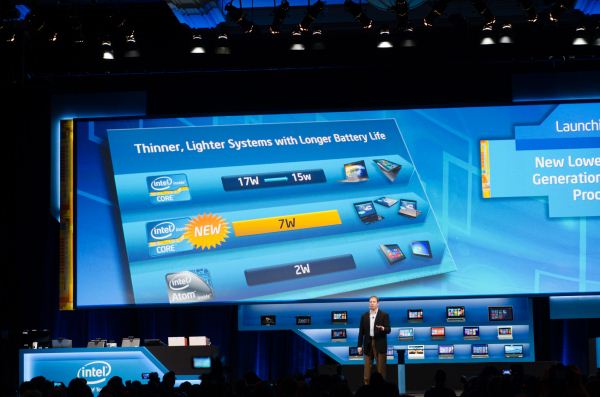
With Haswell, Intel promised to deliver SKUs as low as 10W. That's not quite low enough to end up in an iPad, but it's clear where Intel is headed. In a brief statement at the end of last year, Intel announced that it would bring a small amount of 10W Ivy Bridge CPUs to market in advance of the Haswell launch. At IDF we got a teaser that Intel could hit 8W with Haswell, and given that both Haswell and Ivy Bridge are built at 22nm with relatively similar architectures it's not too far of a stretch to assume that Ivy Bridge could also hit a similar power target. Then came the CES announcement: Intel will deliver 7W Ivy Bridge SKUs starting this week. Then came the fine print: the 7W SKUs are rated at a 10W or 13W TDP, but 7W using Intel's Scenario Design Power (SDP) spec. Uh oh.

Let's first look at the new lineup. The table below includes both the new Y-series SKUs as well as the best 17W U-series SKUs:

Low TDP Intel Core Processor Comparison
Pentium 2129Y
Core i3-3229Y
Core i5-3339Y
Core i5-3439Y
Core i5-3317U
Core i7-3689Y
Core i7-3517UE
Nominal TDP
10W
13W
17W
13W
17W
cTDP Down
-
10W
13W
10W
13W
SDP
7W
-
7W
-
Cores/Threads
2/2
2/4
Base CPU Clock
1.1GHz
1.4GHz
1.5GHz
1.5GHz
1.7GHz
1.5GHz
1.7GHz
1C Turbo
-
-
2.0GHz
2.3GHz
2.6GHz
2.6GHz
2.8GHz
2C Turbo
-
-
1.8GHz
2.1GHz
2.4GHz
2.4GHz
2.6GHz
L3 Cache Size
2MB
3MB
4MB
GPU
HD
HD 4000
Base GPU Clock
350MHz
Max GPU Clock
850MHz
1.05GHz
850MHz
1.1GHz
Quick Sync
No
Yes
AES-NI
No
Yes
VT-d
No
Yes
VT-x
Yes
Socket
FCBGA-1023
Price
$150
$250
$250
$250
$225
$362
$330

Compared to a similarly configured U-series part, moving to a Y-series/7W part usually costs you 200MHz in base clock, ~250MHz in max GPU clock, and 200 - 300MHz in max turbo frequency. Cache sizes, features and Hyper Threading are non-negotiable when going between U and Y. The lower clocks are likely the result of lower operating voltages and a side effect of the very low leakage binning. The cost of all of this? Around an extra $30 over a similar U-SKU. That doesn't sound like much but when you keep in mind that most competing ARM based SoCs sell for $30 themselves, it is a costly adder from an OEM's perspective.

Now the debate.

Intel should have undoubtedly been very specific about 7W being an SDP distinction, especially when the launch slide compared it to TDPs of other Intel parts. Of course Intel failed to do this, which brought on a lot of criticism. To understand how much of the criticism was warranted we need to first understand how Intel comes up with a processor's TDP and SDP ratings.

Intel determines a processor's TDP by running a few dozen workloads on the product and measuring thermal dissipation/power consumption. These workloads include individual applications, multitasking workloads (CPU + GPU for example) and synthetic measures that are more closely related to power viruses (e.g. specifically try to switch as many transistors in parallel as possible). The processor's thermal behavior in all of these workloads ends up determining its TDP at a given clock speed.

Scenario Design Power (SDP), on the other hand, is specific to Intel's Y-series SKUs. Here Intel takes a portion of a benchmark that stresses both the CPU and GPU (Intel wouldn't specify which one, my guess would be something 3DMark Vantage-like) and measures average power over a thermally significant period of time (like TDP, you're allowed to violate SDP so long as the average is within spec). Intel then compares its SDP rating to other, typical touch based workloads (think web browsing, email, gaming, video playback, multitasking, etc...) and makes sure that average power in those workloads is still below SDP. That's how a processor's SDP rating is born.

If you run a power virus or any of the more stressful TDP workloads on a Y-series part, it will dissipate 10W/13W. However, a well designed tablet will thermally manage the CPU down to a 7W average otherwise you'd likely end up with a device that's too hot to hold.

Intel's SDP ratings will only apply to Y-series parts, the rest of the product stack remains SDP-less. Although it debuted with Ivy Bridge, we will see the same SDP ratings applied to Haswell Y-series SKUs as well. Although Y-series parts will be used in tablets, there are going to be some ultra-thin Ultrabooks that use them as well. In a full blown notebook there's a much greater chance of a 7W SDP Ivy Bridge hitting 10W/13W, but once again the burden falls upon the OEM to properly manage thermals to deliver a good experience.

The best comparison I can make is to the data we saw in our last power comparison article. Samsung's Exynos 5 Dual (5250) generally saw power consumption below 4W, but during an unusually heavy workload we saw it jump up to nearly 8W. While Samsung (and the rest of the ARM partners) don't publicly specify a TDP, going by Intel's definition 4W would be the SoC's SDP while 8W would be its TDP if our benchmarks were the only ones used to determine those values.

Ultimately that's what matters most: how far Intel is away from being able to fit Core into an iPad or Nexus 10 style device. Assuming Intel will be able to get there with Ivy Bridge is a bit premature, and I'd probably say the same thing about Haswell. The move to 14nm should be good for up to a 30% reduction in power consumption, which could be what it takes. That's a fairly long time from now (Broadwell is looking like 2H-2014), and time during which ARM will continue to strengthen its position.


Acer's W700 refresh, with 7W SDP Ivy Bridge in tow


As for whether or not 7W SDP parts will actually be any cooler running than conventional 10W/13W SKUs, they should be. They will run at lower voltages and are binned to be the lowest leakage parts at their target clock speeds. Acer has already announced a successor to its W700 tablet based on 7W SDP Ivy Bridge with a 20% thinner and 20% lighter chassis. The cooler running CPU likely has a lot to do with that.

Then there's the question of whether or not a 7W SDP (or a future 5W SDP Haswell/Broadwell) Core processor would still outperform ARM's Cortex A15. If Intel can keep clocks up, I don't see why not. Intel promised 5x the performance of Tegra 3 with a 7W SDP Ivy Bridge CPU. Cortex A15 should be good for around 50% better performance than Cortex A9 at similar frequencies, so there's still a decent gap to make up.

At the end of the day, 7W SDP Ivy Bridge (and future parts) are good for the industry. Intel should have simply done a better (more transparent) job of introducing them.


作者: Cherbim    时间: 2013-1-14 16:57
提示: 作者被禁止或删除 内容自动屏蔽
作者: the_god_of_pig    时间: 2013-1-14 17:01
另外ivb-Y平板规格:11.6寸的10mm厚,800g重,续航不明

大概比同尺寸的atom平板厚1mm,重70-80g
作者: seslove    时间: 2013-1-14 18:18
800克真的太重了,上次买了台tegra2的联想think pad平板重量700多克没用两个星期手就痛了,以后用一次手痛一次,最后送人了。

因此我认为:平板最重不能过700,最好能控制在600以下。

提醒各位网友,使用平板小心肩膀痛,我现在就时常痛,而且使用平板不过2年。
作者: the_god_of_pig    时间: 2013-1-14 18:56
seslove 发表于 2013-1-14 18:18
800克真的太重了,上次买了台tegra2的联想think pad平板重量700多克没用两个星期手就痛了,以后用一次手痛一 ...

想单手用得舒服得上7寸的
双手的话700g左右可以接受


作者: zjh988    时间: 2013-1-14 19:09
the_god_of_pig 发表于 2013-1-14 18:56
想单手用得舒服得上7寸的
双手的话700g左右可以接受

7寸单手,呵呵!表示遗憾!正常用8-9寸比较合适!
作者: kinno    时间: 2013-1-15 01:07
T神你看懂了吗?
作者: Tempestglen    时间: 2013-1-15 08:04
提示: 作者被禁止或删除 内容自动屏蔽
作者: scp8332    时间: 2013-1-15 08:10
           其实我真的不信arm有那么牛逼,工艺赶不上intel,还能在同样功耗下性能完秒intel,或者同样性能下功耗完秒intel。。。。这基本上很难,intel一直称霸这么多年。。。而且一直在高速前进。。。。。不能说intel进入移动领域会对arm造成多大的灾难,但是intel绝对不是小鸟。。。大鳄级别的人物,不能让人忽视,绝对可以撼动arm的移动霸主地位了。。。最后只是希望能出现更强更节能的处理器造福大家。。。。
作者: itany    时间: 2013-1-15 10:45
Tempestglen 发表于 2013-1-15 08:04
2C的1.1Ghz 赛扬847已经被四核A15@2Ghz击败,sun spider分别是525ms vs 550ms,单线程性能相当,  arm有四核 ...

呵呵,那只是Intel在开发32nm和22nm的时候没有优先LP制程,而开发CPU的路线上Atom并没有得到足够的资源而已。
作者: Tempestglen    时间: 2013-1-15 10:49
提示: 作者被禁止或删除 内容自动屏蔽
作者: the_god_of_pig    时间: 2013-1-15 11:37
Tempestglen 发表于 2013-1-15 08:04
2C的1.1Ghz 赛扬847已经被四核A15@2Ghz击败,sun spider分别是525ms vs 550ms,单线程性能相当,  arm有四核 ...

自欺欺人也要有个限度


你的A15TDP已经8-9瓦,和10瓦TDP的Haswell/ivb有什么区别?


天天拿个fanless当救命稻草,你不知道不少有风扇设备现在都有"安静模式"了?


注意,在平板上,99%的消费者不会去玩数值计算,你那spec测试还是省省吧,通用cpu的权威测试到了平板领域,就不一定合适了。99%的消费者主要以上网为主,你那525ms的sun spider,有个屁优势。

别逃跑,SPEC CPU被惨虐就去YY娱乐js跑分对吧,还TM拿个赛扬当对手,你也就这点出息


作者: Tempestglen    时间: 2013-1-15 11:55
提示: 作者被禁止或删除 内容自动屏蔽
作者: the_god_of_pig    时间: 2013-1-15 11:58
Tempestglen 发表于 2013-1-15 11:55
是没区别,2013年我如果看不到10寸fanless续航10小时重量700克以下的ivb/haswell平板,你就被踢爆了。

耍什么无赖,你说踢爆就踢爆?

如果今年ARM sunspider跑分到不了3xxms你就被踢爆了,休想逃跑

作者: Tempestglen    时间: 2013-1-15 13:18
提示: 作者被禁止或删除 内容自动屏蔽
作者: the_god_of_pig    时间: 2013-1-15 13:23
Tempestglen 发表于 2013-1-15 13:18
今年arm 无需sun spider跑350ms。

因为ivb上不了ipad,哈哈即使勉强上了个笨重pad,单线程优势也会被2 ...


上ipad?你的A15四核全开能上ipad?

比性能时拿全开必须有风扇的A15来凑数,比重量时候拿性能被四核A15秒飞的ipad是吧

你也就这么点套路了

作者: Tempestglen    时间: 2013-1-15 14:39
提示: 作者被禁止或删除 内容自动屏蔽
作者: the_god_of_pig    时间: 2013-1-15 15:15
Tempestglen 发表于 2013-1-15 14:39
上nexus10也行啊,下一代nexus10就要更新exynos哟。

Nexus10?你说的是那个硬把TDP从8瓦自宫到4瓦、CPU GPU同时高载就降频800Mhz的玩艺吗?
作者: Tempestglen    时间: 2013-1-15 15:20
提示: 作者被禁止或删除 内容自动屏蔽
作者: the_god_of_pig    时间: 2013-1-15 15:28
Tempestglen 发表于 2013-1-15 15:20
自宫之后跑650ms 的sun spider没问题,你的赛扬847自宫到800Mhz,估计也是650ms德性。

发什么梦,Sunspider能同时高载GPU和CPU?

1.7G 650ms,也不怎么样

另外ARM也就是和赛扬比比这点出息了,另外告诉你个坏消息赛扬847不打算上平板
作者: Tempestglen    时间: 2013-1-15 15:42
提示: 作者被禁止或删除 内容自动屏蔽
作者: the_god_of_pig    时间: 2013-1-15 15:48
Tempestglen 发表于 2013-1-15 15:42
snb 1.6Ghz跑出300ms,也就是这样了。snb上了平板呆在0.8ghz左右,也是600ms的德性。A15是四核对付双核 ...
snb上了平板呆在0.8ghz左右


你除了发梦就没点新鲜的?ivb上了平板可以跑2.6G

另外Windows的js跑分和安卓有可比性?玩耍赖谁不会,我看你那5250 sunspider跑分只能算850ms

"A15是四核对付双核snb"


你是不是以为平板设备除了跑你的救命稻草sunspider以外什么都不干了?

作者: Tempestglen    时间: 2013-1-15 15:51
提示: 作者被禁止或删除 内容自动屏蔽
作者: the_god_of_pig    时间: 2013-1-15 15:59
本帖最后由 the_god_of_pig 于 2013-1-15 16:00 编辑
Tempestglen 发表于 2013-1-15 15:51
哟,上平板可以跑2.6Ghz,那赛扬1.1Ghz怎么还没上平板?

莫非是你猪神诅咒的?

又神志不清了阿?10瓦的奔腾2129Y不就是1.1G的吗?另外它还有个10瓦的亲戚叫i7-3689Y,默频1.5G,turbo 2.6G带HT、4MB L3

看来ARM永远只能和Intel手下的太监比一比了阿?


欢迎光临 POPPUR爱换 (https://we.poppur.com/) Powered by Discuz! X3.4